
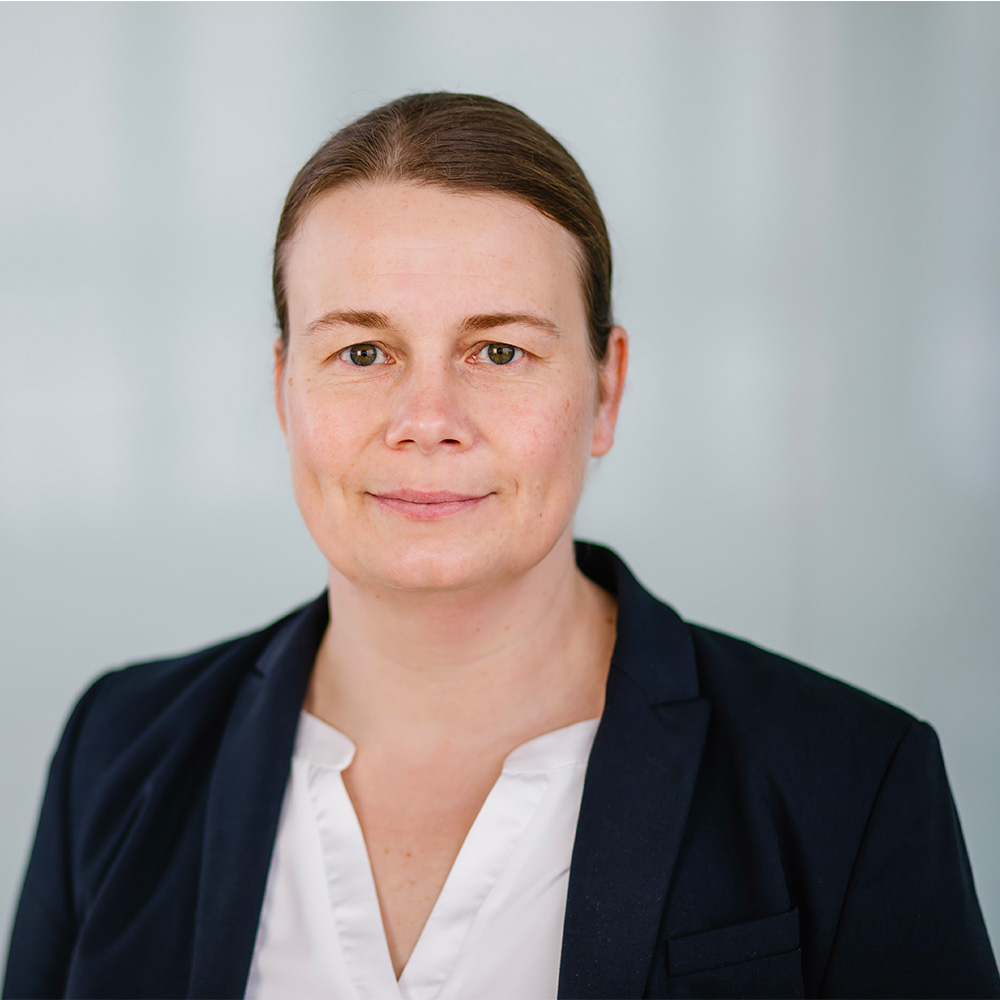
Julia Wandt is an expert in communication and strategy with a focus on higher education and science communication, strategy development for scientific institutions, and scientific policy consulting. She has over twenty years of professional experience at universities (Göttingen, Konstanz, and Freiburg) and as a consultant in the German science system. In addition, she regularly serves as a reviewer and expert on the status quo and future of the science system (e.g., for the German Research Foundation, the Federal Ministry of Research, Technology and Space, and the German Bundestag). In fall 2021, together with colleagues, she initiated the Scicomm-Support, the German national contact for attacks and unobjective conflicts in science communication, which began its work in July 2023. Since then, she has been one of three volunteer coordinators of the Scicomm-Support.
Kristin Küter is an expert in providing support and advice to researchers and science communicators who experience science hostility and attacks. She contributes this to her role at the Scicomm-Support. Previously, she gained experience working at Wissenschaft im Dialog as project lead of the Scicomm-Support and also, among other, on the project “Wissenschaft kontrovers”.
Before entering this field, Kristin Küter was a researcher in social sciences as well as working in the field of crisis communication. She completed both her Bachelor’s and Master’s degrees in Social Sciences at the Humboldt-Universität zu Berlin and additionally holds a Bachelor’s degree from Hotelschool The Hague
In our presentation we will address “ReGeneration” at the interface of “what it means to change our professional practices, institutional cultures ...” against the backdrop of “steering science communication in a climate of mistrust”. The Scicomm-Support is the German National Contact Point point for attacks and unobjective conflicts in science communication for Germany, Austria and Switzerland. Last year, we started building up an international network of all countries worldwide with a comparable contact point or an interest in establishing one.
When steering science communication in this climate and, fundamentally, against the backdrop of current (especially political) developments in Europe and globally, the question is precisely this: What do we need to reorganize/regenerate in science communication in order to not only contribute here with regard to the protection and resilience of science and science communication itself?
The aims of the network are (1) to connect all institutions and individuals working on this “regeneration” worldwide, (2) to provide concrete support to countries that want to set up support measures against hostility towards science and (3) to send a clear worldwide signal for the proactive renewal in what we can all together to save science and its freedom. In addition, there is the aspect of “mental health”, which is another motivation (among many) for the work of such initiatives to support researchers, science communicators and research institutions itself against hostility towards science.
In our presentation with discussion we will share our experiences, also from discussions e. g. at UNESCO in Paris in June 2025, and we would like to provide you with a forum for exchange and collaboration within this network. France is also part of this network, and we will also invite a guest from there.
Presentation with Kristin Küter